Artificial intelligence is everywhere in today’s world—from voice assistants and recommendation engines to medical diagnostics and self-driving cars.
But one of the most common sources of confusion is the terminology itself.
People often use artificial intelligence (AI), machine learning (ML), and deep learning (DL) as if they mean the same thing.
They don’t.
These three concepts are closely related, but they describe different layers of technology.
This guide explains what each term really means, how they connect, and where they differ, so you can better understand the systems shaping modern life.
1. What Is Artificial Intelligence?
Artificial intelligence is the broad science of making machines capable of performing tasks that normally require human intelligence.
It is the oldest and largest concept of the three—an umbrella field that dates back to the 1950s.
Key Capabilities of AI
AI systems are designed to:
- Perceive the world (through cameras, sensors, or microphones).
- Reason and draw conclusions based on available information.
- Learn from data and improve performance over time.
- Act autonomously to achieve goals.
Examples of AI Applications
- Virtual assistants like Siri, Alexa, and Google Assistant.
- Expert systems that diagnose medical conditions.
- Robotics for manufacturing and warehouse automation.
- Game-playing algorithms like DeepMind’s AlphaGo.
- Fraud detection in banking and e-commerce.
Importantly, AI does not have to involve machine learning.
Traditional AI systems can be entirely rule-based, following expert-written logic without any self-learning.
This makes AI the outer layer of our conceptual model, with machine learning and deep learning nested inside.
2. What Is Machine Learning?
Machine learning is a subset of AI that focuses on algorithms that learn patterns from data and improve their performance over time without being explicitly programmed.
Instead of relying on static rules, machine learning systems:
- Ingest large volumes of labeled or unlabeled data.
- Identify patterns or relationships within that data.
- Use those patterns to make predictions or decisions.
Core Types of Machine Learning
- Supervised learning: Models are trained on labeled data.
Example: Email spam filters trained on examples of spam vs. legitimate messages. - Unsupervised learning: Models find hidden structures in unlabeled data.
Example: Customer segmentation in marketing. - Reinforcement learning: Models learn by trial and error, receiving rewards or penalties.
Example: Training a robot to navigate an obstacle course.
Everyday Applications
- Recommendation engines (Netflix, YouTube, Amazon).
- Predictive maintenance in manufacturing.
- Fraud detection in banking and credit card networks.
- Weather forecasting and supply chain optimization.
Machine learning is the engine that powers most modern AI breakthroughs.
However, not every AI system uses ML—for instance, a classic chess program that follows fixed rules is AI but not machine learning.
3. What Is Deep Learning?
Deep learning is a specialized subset of machine learning that uses artificial neural networks with multiple layers (“deep” networks) to automatically learn from large volumes of complex, unstructured data.
Where traditional machine learning often requires manual feature engineering (humans decide which data characteristics to emphasize), deep learning networks discover those features themselves.
How Deep Learning Works
- Input Layer: Receives raw data such as images, sound waves, or text.
- Hidden Layers: Each layer extracts increasingly abstract features.
- Output Layer: Produces predictions or classifications.
These networks are inspired by the structure of the human brain, but they do not think like humans.
They excel at detecting intricate patterns when provided with vast datasets and significant computing power.
Real-World Deep Learning Applications
- Image and object recognition for autonomous vehicles.
- Natural language processing (ChatGPT, Google Gemini).
- Voice assistants with real-time speech translation.
- Medical imaging to identify tumors or eye diseases.
- Generative AI for creating realistic images, video, and music.
Deep learning represents the cutting edge of machine learning, enabling machines to tackle tasks—like free-form language generation and real-time image recognition—that were once science fiction.
Visualizing the Relationship
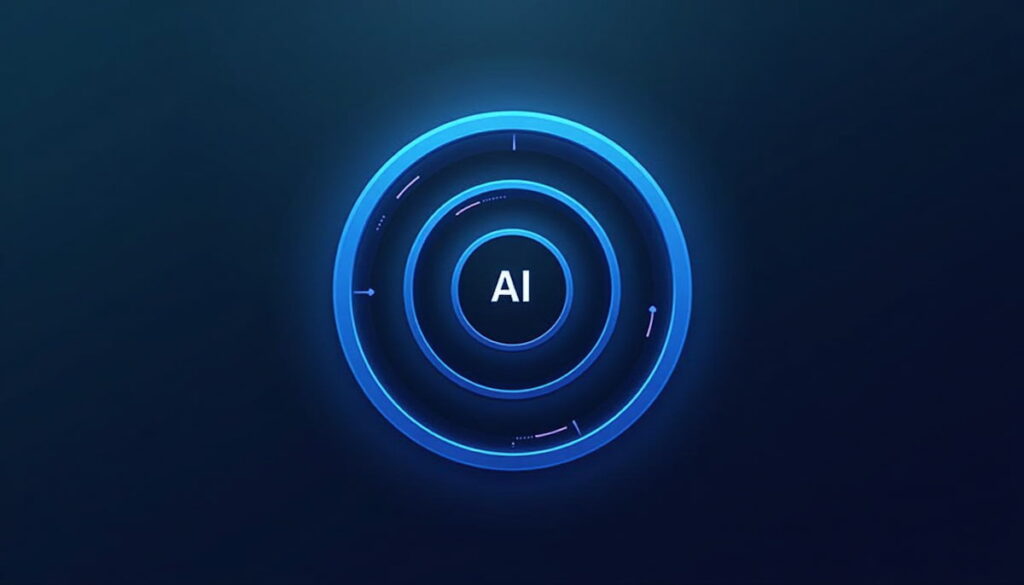
The relationship among the three concepts can be visualized as nested circles:
Artificial Intelligence
   └─ Machine Learning
         └─ Deep Learning
- AI is the broad field focused on creating intelligent machines.
- Machine Learning sits inside AI, focusing on systems that learn from data.
- Deep Learning sits inside machine learning, using layered neural networks for advanced pattern recognition.
This hierarchy makes it clear:
All deep learning is machine learning, and all machine learning is AI, but not all AI involves machine learning or deep learning.
Key Differences at a Glance
| Aspect | Artificial Intelligence | Machine Learning | Deep Learning |
|---|---|---|---|
| Scope | Broad science of intelligent machines | Subset of AI focused on data-driven learning | Subset of ML using deep neural networks |
| Approach | Can be rule-based or data-driven | Uses algorithms to learn patterns from data | Automatically extracts features from raw data |
| Data Requirements | Can work with limited data | Needs moderate, structured data | Requires massive, often unstructured datasets |
| Human Involvement | Heavy in rule design and logic | Some feature engineering and parameter tuning | Minimal feature engineering; high computational needs |
| Typical Uses | Robotics, expert systems, planning, natural language processing | Recommendations, forecasting, fraud detection | Image recognition, self-driving cars, large language models |
Choosing the Right Approach
For businesses and developers, choosing between traditional AI, machine learning, or deep learning depends on the problem and available data.
When Traditional AI Makes Sense
- When tasks can be fully described with explicit rules and logic.
- Examples: tax calculators, rule-based chatbots, automated scheduling.
When Machine Learning Is the Best Fit
- When you have structured data and need predictions or classification.
- Examples: predicting sales, recommending products, detecting spam.
When Deep Learning Is Essential
- When data is unstructured (images, audio, video) or extremely large.
- Examples: medical imaging, natural language generation, autonomous vehicles.
Selecting the right level avoids wasted resources and ensures faster, more reliable solutions.
Emerging Trends and the Future
The boundaries among AI, machine learning, and deep learning continue to shift as research advances.
- Hybrid AI Models
Researchers are combining symbolic reasoning (traditional AI) with machine learning for systems that are both powerful and explainable. - Edge AI
Machine learning and deep learning models will increasingly run on small devices—from smartphones to IoT sensors—enabling real-time decisions without cloud latency. - Multimodal AI
Large models that handle text, images, audio, and video simultaneously (like OpenAI’s GPT-4o) will blur the lines between ML and DL even further. - Energy-Efficient Training
New hardware and algorithms will make deep learning more sustainable, reducing the environmental footprint of massive model training.
As these technologies converge, understanding the core distinctions will remain critical for businesses and individuals alike.
Common Misconceptions
Despite the progress, several myths still surround AI, ML, and DL:
| Myth | Reality |
|---|---|
| AI is about human-like consciousness | Current AI lacks self-awareness; it’s pattern recognition and decision-making. |
| Machine learning models “understand” like humans | They detect statistical relationships, not meaning. |
| Bigger neural networks equal human-level thinking | More layers mean better pattern recognition, not independent thought. |
| AI will replace all jobs | It will automate tasks and create new roles, requiring adaptation rather than simple replacement. |
Clarifying these misconceptions helps people evaluate claims realistically and use the technologies wisely.
Key Takeaways
- AI is the umbrella field concerned with creating machines that can act intelligently.
- Machine Learning is a subset of AI that enables systems to learn from data and improve performance.
- Deep Learning is a subset of machine learning that uses layered neural networks to handle very large and complex datasets.
Understanding these layers is vital for:
- Businesses planning technology investments.
- Developers choosing the right tools.
- Consumers evaluating AI-powered products and services.
Artificial intelligence, machine learning, and deep learning are often mentioned in the same breath—but they represent different levels of technology and specialization.
- Artificial Intelligence is the overarching field of building machines that can reason, learn, and act.
- Machine Learning is the main method by which AI systems learn patterns and make predictions from data.
- Deep Learning is the cutting edge of machine learning, using layered neural networks to master complex, unstructured data like images, audio, and natural language.
Keeping these distinctions clear helps cut through hype, set realistic expectations, and choose the best technology for each challenge.
Whether you’re a business leader, developer, or curious reader, knowing the difference between AI, machine learning, and deep learning is the key to understanding—and benefiting from—the future of intelligent technology.