Artificial Intelligence (AI) is everywhere—from voice assistants on smartphones to medical imaging systems in hospitals—but it’s also surrounded by myths and marketing buzz.
Some headlines portray AI as a near-magical force, while others warn of machines plotting against humanity.
The truth is both more grounded and more exciting.
This guide cuts through the hype to explain what AI actually is, what it isn’t, how it works, and why it matters—today and in the future.
Understanding Artificial Intelligence
At its core, artificial intelligence is the science and engineering of creating machines that can perform tasks that typically require human intelligence.
Those tasks include learning from experience, recognizing patterns, reasoning, making decisions, and understanding natural language.
AI isn’t a single technology. It’s a field of computer science that includes multiple overlapping areas:
- Machine Learning (ML): Algorithms that improve as they process more data.
- Deep Learning: Neural networks that mimic the way the human brain processes information, excellent for speech, image, and language tasks.
- Natural Language Processing (NLP): Systems like ChatGPT that can analyze and generate human-like text.
- Computer Vision: Recognizing and interpreting images or video.
- Robotics: Combining sensors, algorithms, and mechanical components for tasks like assembly, exploration, or autonomous driving.
Think of AI as a toolbox of methods and technologies working together to help machines perceive, learn, and act.
What AI Really Does
AI’s real power lies in its ability to recognize patterns and make predictions across massive datasets far faster than humans can.
Here are some core capabilities:
Pattern Recognition & Prediction
AI excels at spotting patterns—whether it’s detecting credit card fraud, recognizing faces, or predicting when a machine part will fail.
This is why recommendation systems (like Netflix suggesting a show) and medical imaging analysis work so well.
Learning From Data
Instead of following a single pre-written script, machine learning algorithms improve through exposure to new information.
- Supervised learning uses labeled data (like thousands of tagged images) to teach the system what to recognize.
- Unsupervised learning discovers patterns on its own, such as grouping customers by purchasing behavior.
- Reinforcement learning trains an AI agent to take actions in an environment (think self-driving cars or game-playing bots).
Decision-Making Algorithms
AI models weigh probabilities and outputs to choose the best action—whether it’s setting the optimal delivery route or adjusting supply chains.
Everyday Real-World Examples
- ChatGPT and large language models for text generation and research help.
- Autonomous vehicles that analyze sensor data to navigate roads.
- Smart assistants like Siri or Google Assistant that understand spoken commands.
- E-commerce platforms that predict what customers want next.
These examples show that AI is powerful, practical, and already embedded in daily life—but not magical.
What AI Is Not
Despite media headlines and science-fiction movies, AI is not alive, sentient, or conscious.
It does not possess desires, emotions, or self-awareness.
Here are common misconceptions and the reality behind them.
| Myth | Reality |
|---|---|
| AI will soon be self-aware | Current AI lacks consciousness and intent. |
| AI understands language like a human | It predicts word patterns without true comprehension. |
| AI will replace every job | It automates tasks but creates new roles and industries. |
| AI is one big system | It’s a collection of techniques and tools, not a single machine brain. |
| AI can think creatively like humans | It reuses patterns in data—it doesn’t originate ideas. |
In short, AI is mathematics and code, not magic or mind.
How AI Actually Works
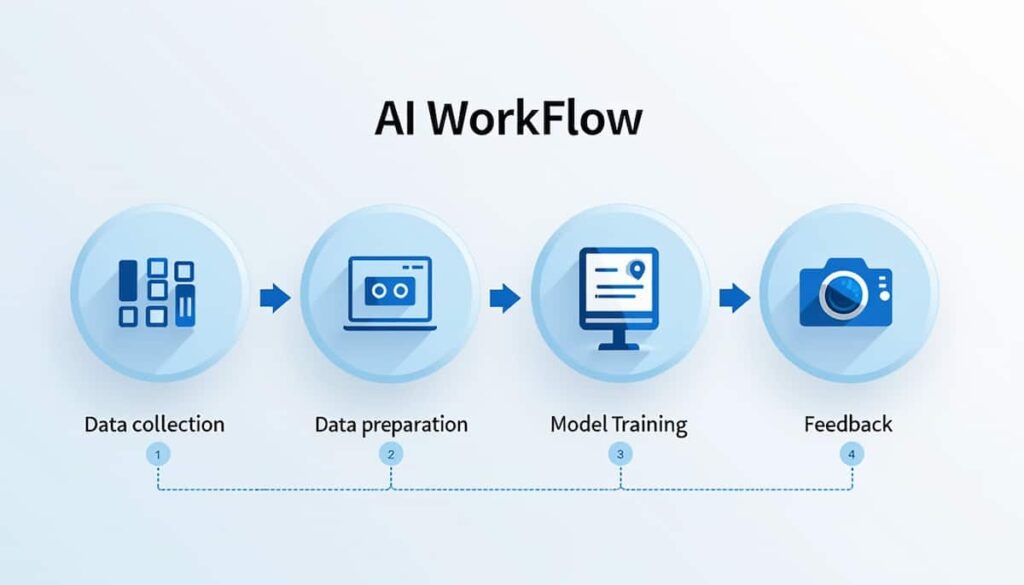
Every AI system follows a broad but clear process:
- Data Collection – Gathering large, diverse datasets: images, text, voice, sensor readings.
- Data Preparation – Cleaning, labeling, and structuring data so algorithms can use it.
- Model Training – Feeding data into algorithms so they can learn patterns and relationships.
- Evaluation & Tuning – Testing performance and adjusting parameters for accuracy.
- Deployment & Feedback – Integrating the trained model into apps, websites, or hardware and updating it as new data arrives.
The key ingredients are high-quality data and massive computing power (GPUs, TPUs, and cloud infrastructure).
Without enough clean, representative data, even the most sophisticated model will produce biased or unreliable results.
The Real-World Impact of AI
AI is no longer confined to research labs.
It’s reshaping industries and daily life in tangible ways.
Healthcare
- AI scans medical images to detect early signs of cancer or heart disease.
- Predictive analytics help hospitals manage patient loads and improve care.
Finance
- Algorithms detect fraud in real time.
- Robo-advisors assist with investments and risk analysis.
Retail & Marketing
- E-commerce platforms use AI to recommend products and optimize pricing.
- Supply chains use predictive analytics to minimize shortages.
Transportation
- Self-driving technology powers delivery robots and autonomous vehicles.
- AI improves route planning and traffic management for airlines and shipping companies.
These are not future possibilities—they are current realities, quietly running behind the scenes.
The Limits and Challenges of AI
For all its promise, AI has important limitations and risks.
Data Bias and Fairness
AI can reflect or even amplify human biases if the training data is skewed.
Facial recognition systems, for example, may misidentify people of certain demographics if those groups were underrepresented in the data.
Energy and Environmental Costs
Training large AI models consumes vast computing power and electricity.
Sustainable AI requires more efficient hardware and algorithms.
Privacy and Data Ownership
Wearables, smart assistants, and AI-driven apps collect intimate details about daily life.
Without strict controls, this data could be misused.
Regulation and Ethics
Governments and industry bodies are still developing rules around safety, transparency, and accountability.
Striking a balance between innovation and responsibility is an ongoing challenge.
The Future of AI: What to Expect
The next decade will bring smarter, more human-like interactions—but still without true consciousness.
Natural Interfaces
AI will feel more conversational and intuitive.
Voice assistants, augmented reality, and real-time translation will be seamless.
Deeper Industry Integration
Education, agriculture, energy management, and small business operations will increasingly depend on AI-driven insights.
Predictive and Preventive Healthcare
From wearable devices to AI diagnostics, early detection of illness will become routine.
Stronger Governance
Global frameworks for AI safety, ethics, and privacy will continue to evolve, ensuring transparent and accountable use.
AI’s future isn’t about robots taking over; it’s about humans and machines working side by side, amplifying human capabilities.
Key Takeaways
Artificial Intelligence is a powerful set of tools and methods for pattern recognition, learning, and decision-making.
It already drives everyday conveniences and critical services, from personalized shopping to life-saving medical scans.
But AI is not sentient.
It doesn’t think, feel, or desire.
Its success depends on human-designed data, algorithms, and oversight.
Understanding these realities helps individuals and businesses:
- use AI confidently,
- guard against misuse,
- and embrace opportunities for creativity, efficiency, and better decision-making.
AI is here to stay—not as a science-fiction villain or all-knowing oracle, but as a sophisticated partner in progress.
By separating fact from fiction, we can focus on what really matters: building trustworthy systems, using AI ethically, and leveraging its capabilities to solve real-world problems.
Whether it’s optimizing supply chains, detecting diseases early, or powering the next generation of smart tools, AI’s future is about collaboration, not competition with humans.
With informed use and thoughtful regulation, artificial intelligence can help create a more efficient, creative, and healthy world.